Maximize Margins in 2026 with Effective Feed Ingredient Planning and Contracting
FEATURED EXPERTS:
- John Robinson, professor and extension specialist – cotton marketing at Texas A&M University
- David Anderson, professor and extension specialist – livestock and food product marketing at Texas A&M University
- Amy May Hopper, profit center manager at The Andersons, Inc.
When it comes to achieving profitability on cattle operations, feed prices and availability are big pieces of the puzzle. Understanding the fluctuating markets can help both dairy and beef producers plan for 2026 while maintaining budgets. We sat down with three industry experts to discuss what to expect in feed commodity and cattle markets in the year ahead.
2025 Production Leads to Increased Whole Cottonseed Supply
Cottonseed is a nutrient-dense feed ingredient for cattle that many producers evaluate when developing their feed programs.1 Since cottonseed is a byproduct of cotton, examining cotton production and price outlooks is a great place to start making your 2026 plans.
Looking at what happened in 2025, John Robinson, cotton marketing professor and extension specialist at Texas A&M University, says overall, last year brought stable cotton production amidst rising pressures from outside forces.
“Favorable weather conditions, including ample moisture during plant growth stages and dryness at harvest, resulted in slightly above-average yields in the central southern region. On the other hand, this moisture negatively impacted production in the southeast, with excessive wetness causing greater rates of abandonment and lower overall production,” he explains.
As of January 12, 2026, the United States Department of Agriculture (USDA) estimated a total of 13.9 million bales of production in 2025.2 Amy May Hopper, who specializes in supplying cottonseed for cattle producers in her role as a profit center manager for Anderson Inc., says recent carryout data supports this production.
“Carryout is going to help supplement 2025 production. Right now, the numbers lie in their typical range, with healthy carryout for 2026,” she says.
Robinson expects planting numbers may be close to that of last year, but 2026 will likely be a slightly lighter year for cotton production due to weather.
“Based on the relationship between relative price of new crop corn and new crop cotton, I predict planted acreage of cotton will be in the neighborhood of what we saw in 2025… However, the weather forecasted by the USDA’s U.S. Drought Monitor and IRI Probabilistic ENSO Forecast show dryness is expected in the Cotton Belt through winter,3,4 followed by normal conditions in the spring,4 which opens the door for more weather risk,” Robinson states.
Robinson hypothesized the dryness at the start of the season may prompt some growers in the south to plant more than normal, but the combination of weather conditions may lead to more abandonment come harvest and overall, a less productive crop for 2026: “The official forecast is La Niña dryness through about February and then normal conditions from that point onward. And the combination of that forecast to my way of thinking leads to more weather risk, and, therefore, more risk to the 2026 crop’s productivity.”
Rising Livestock Prices Could Mean High Profitability for Producers
In the cattle markets, prices are steadily favorable. The year 2025 was defined by record highs: high beef cattle prices, high calf prices, high levels of milk production and, most notably, high profits.5 Excitedly, experts agree 2026 is looking to be another record-breaking year.
David Anderson, livestock professor and extension specialist at Texas A&M University, describes how cow inventory has played out over the last couple years.
On the dairy side, high profits in 2024 gave the signal for producers to expand, leading to the most cow inventory in years.5 The Livestock Marketing Information Center shows in 2025, milk production increased by about 4% year over year5, which Anderson argues is driven by both the increase in herd numbers and the long-term payoffs of expanded processing capacity.
“We’re seeing tremendous growth in this region where we’ve got growing milk processing capacity to support larger dairy herds,” Anderson says.
On the beef side, strong returns in 2025 may prompt cattle producers to add to their herds in the coming year, but experts, including Anderson, presume that growth may be curbed by regional weather conditions.
“One of the big questions is: can we expand our herds? Are we getting the market signal enough in terms of prices to start expanding cattle herd numbers?” he asks.
Anderson looks to the U.S. drought monitor as his source of truth when examining the expansion and profitability of livestock operations.
“How drought develops is going to be a determining factor in our ability to expand cow herds going forward,” he states.
But even in 2026, a year expected to boast high cattle prices, Anderson anticipates herd numbers will stay consistent.
“Our ability to expand and respond to record high cattle prices is going to be tempered by how drought develops, particularly in Texas and the southwest,” Anderson adds. “Our drought monitor certainly highlights some risks going forward…and some hesitancy on the part of ranchers to really expand herds, even though we have record high prices that would tell us we ought to be expanding.”
U.S. Drought Monitor
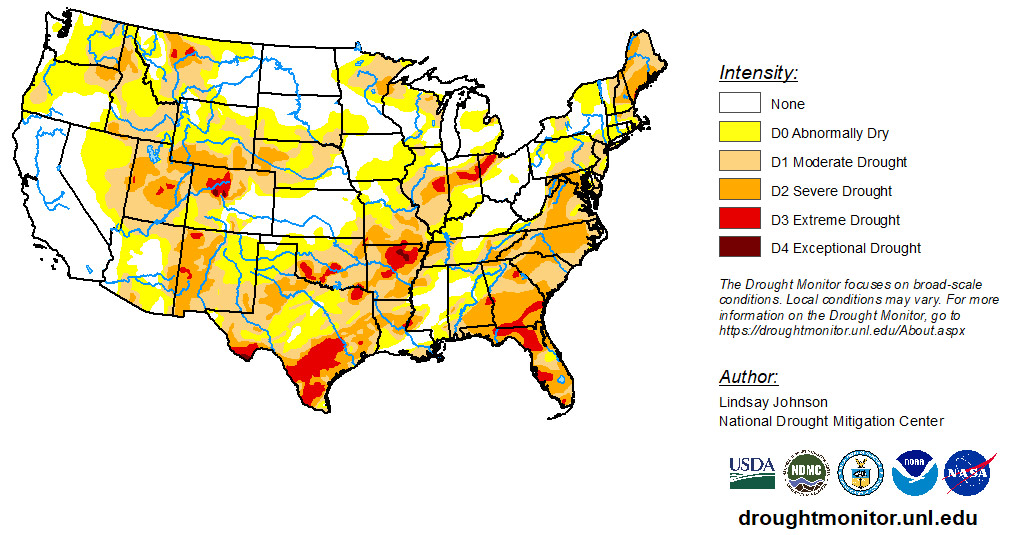
As of February 3, 2025. Produced by USDA with NOAA and NDMC at the University of Nebraska-Lincoln.
Producers also should consider potential drought conditions when thinking about their feed programs for 2026. Dryness in key regions could mean supplemental feeding, specifically additional protein, will be even more critical going forward. This, along with the number of growing herds, could increase the demand for supplements and feedstuffs such as whole cottonseed, an excellent triple-nutrient choice providing fiber, fat and protein6.
Navigating the Shifts in Regional Cottonseed Supply and Demand
If you are a livestock producer or anyone in the industry, you’ve probably noticed or felt the shifts in geographic market dynamics. According to experts, the difference between where cottonseed is produced and consumed is growing wider. Hopper says the Southeast and Mid-South regions have been producing less cotton, leading some producers in these areas to consider sourcing from other regions.
“We are anticipating that the Mid-South and Southeast production numbers will ultimately be down year over year,” Hopper says.
In other parts of the country, demand is driving the change. Parts of Texas and other south-central states are seeing an ever-rising number of dairy cows, signaling an increase in cottonseed supply in those areas.
“We’ve got tremendous growth in this Southern region [in dairy herds]. We know how much cotton we produce in Texas, and so the supply of cottonseed is there to feed right into this growing dairy herd,” says Anderson.
Hopper explains livestock operations in many regions that have historically sourced from the southeast and midsouth, like many western states, are now driving new demand in cotton growing regions closer to them.
“Ultimately, the market will figure out how to supply needs where they’re demanded,” she clarifies.
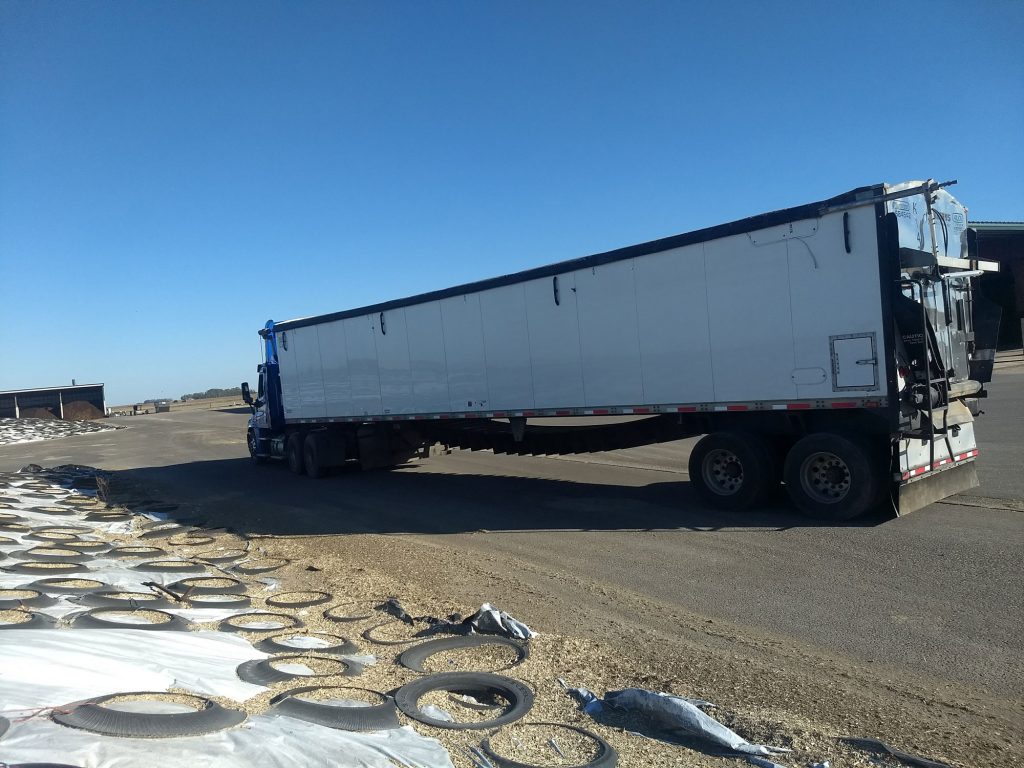
The takeaway for producers? Plan ahead for sourcing and stay aware of market dynamics. If you’re located in a market dependent on the Southeast or Mid-South whole cottonseed supply, you may need to be proactive about sourcing. No matter where you are, forward contracting can help you navigate these complexities. When there’s room for logistical complications to arise, planning ahead allows you to feel confident knowing you have secured a source for your future needs.
Key Considerations for Producers in 2026
Admittedly, it’s challenging to predict exactly what will happen to feedstuff and protein prices, as we enter spring 2026 planting. However, in a fairly volatile market, one thing remains the same: cottonseed’s reliability in the ration. As a three-in-one feedstuff providing the fiber, fat and protein cattle need,5 cottonseed is an ingredient that’s proven difficult to replace.
Forward contracting can help you mitigate the risks of fluctuating markets with individual ingredients and stabilize your feed program as a whole.
Hopper agrees, saying, “One of the benefits of contracting whole cottonseed is that it helps to avoid volatility in the market. By partnering with a supplier to forward contract cottonseed, producers can lock in a price and avoid price volatility.”
This also frees up more time for farmers and ranchers to dedicate to other parts of their operations.
Building long-term relationships with suppliers by forward contracting opens the door for better prices and a consistent transportation schedule that fits your schedule. And once suppliers understand the ins and outs of your operation, they can help you avoid potential logistical issues in the future.

As a producer, 2026 may offer new possibilities and significant earning potential. Whether it’s investing in operational growth or aiming to maximize ROI with what you have, supporting your bottom line with an effective and efficient feed program can help you achieve your goals. Get started with forward contracting your whole cottonseed by visiting the Cottonseed Marketplace: a place for producers to find cottonseed prices, availability and suppliers who meet your unique needs.
1Stewart, L. and Rossi, J. (2010). Using cotton byproducts in beef cattle diets. Bulletin 1311. The University of Georgia and Ft. Valley State University, the United States Department of Agriculture and counties of the state cooperating.
2Crop Production Report. Released January 12, 2025, by the National Agricultural Statistics Service (NASS), Agricultural Statistics Board, United States Department of Agriculture (USDA).
3U.S. Drought Monitor. Produced by the United States Department of Agriculture with NOAA and NDMC at the University of Nebraska-Lincoln. https://droughtmonitor.unl.edu/
4International Research Institute for Climate and Society, 2025. https://iri.columbia.edu/our-expertise/climate/enso/
5United States Department of Agriculture-National Agriculture Statistics Service. Livestock Marketing Information Center.
6Kellogg, D.W., Pennington, J.A., Johnson, Z.B. and Panivivat, R. (2001). Survey of management practices used for the highest producing DHI herds in the United States. J. Dairy. Sci. Vol. 84, Supplement, E120– E127. doi:10.3168/-jds.S0022-0302(01)70206-8.